
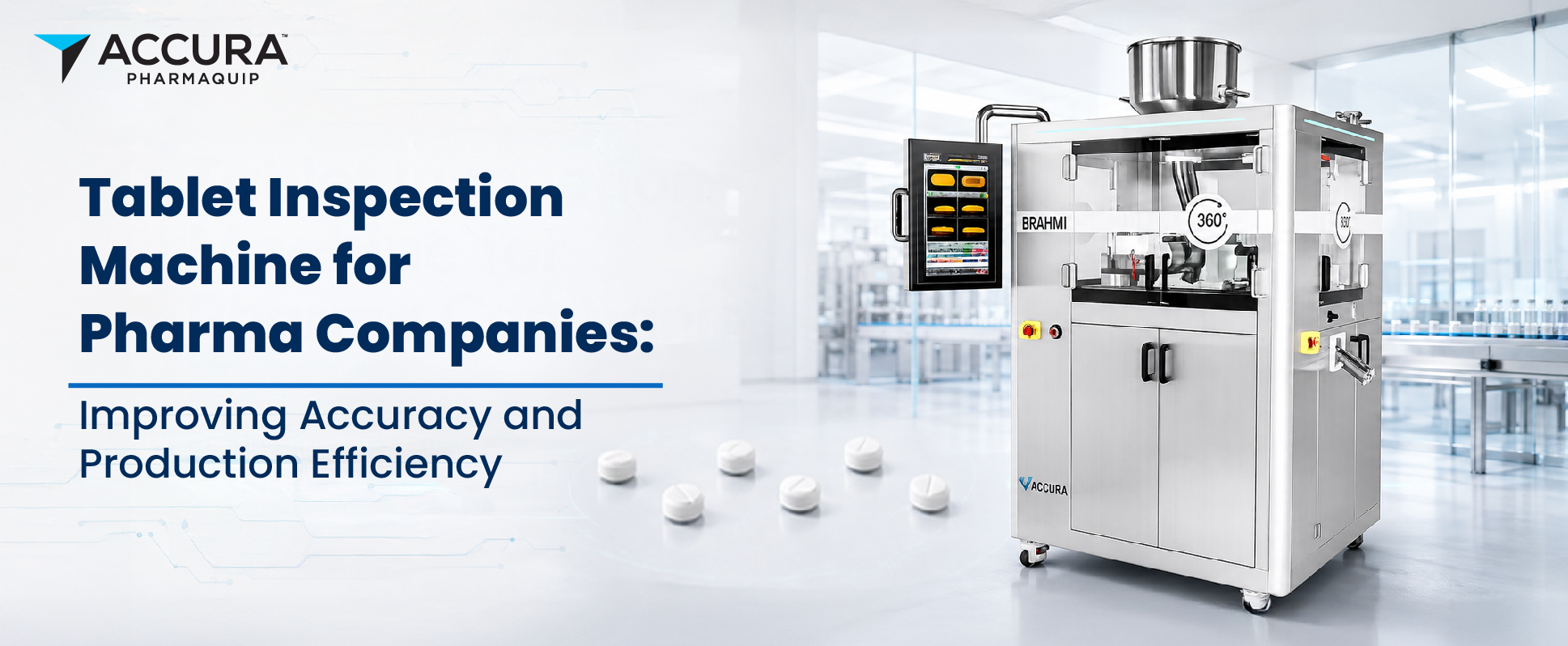
Tablet Inspection Machine for Pharma Companies: Improving Accuracy and Production Efficiency
In pharmaceutical manufacturing, product quality and production efficiency go hand in hand. Every tablet must meet strict standards for appearance, size, shape, integrity, and consistency before it reaches the market. Even minor defects can affect product quality, increase waste, and create compliance challenges.
This is where a tablet inspection machine plays an important role. By automating the inspection process, pharmaceutical manufacturers can identify defective tablets quickly and consistently while maintaining high production speeds.
What Is a Tablet Inspection Machine?
A tablet inspection machine is an automated system designed to inspect tablets for visible and physical defects during pharmaceutical production.
Depending on the machine’s design and inspection technology, it can identify issues such as:
- Cracks and broken tablets
- Chipped edges
- Color variation
- Spots and stains
- Incorrect tablet shape
- Surface defects
- Double tablets or deformed tablets
- Foreign particles or unwanted contamination
Modern inspection systems can use cameras, sensors, lighting systems, and image-processing technologies to examine tablets at high speeds. Defective products can then be automatically separated from acceptable tablets.
Why Is Accurate Tablet Inspection Important?
Pharmaceutical manufacturers cannot afford inconsistent quality control. Manual inspection can be useful for sampling and verification, but inspecting large quantities of tablets manually can be time-consuming and subject to human variability.
A tablet inspection machine provides a more standardized approach. Once the inspection parameters are properly configured, the machine can evaluate tablets according to predefined quality criteria.
This can help manufacturers:
Improve inspection consistency: Automated systems apply the same inspection criteria throughout production.
Detect defects quickly: High-speed inspection allows manufacturers to identify defective tablets without slowing the production line.
Reduce human error: Automation minimizes dependence on visual inspection by individual operators.
Support quality assurance: Inspection data and reject information can help manufacturers monitor production performance and investigate recurring defects.
Improving Production Efficiency
One of the biggest advantages of automated tablet inspection is its ability to combine quality control with high-volume production.
Pharmaceutical production lines may process thousands of tablets in a relatively short period. Inspecting every tablet manually would require significant labor and could potentially create production bottlenecks.
A tablet inspection machine can operate continuously alongside the production line. Tablets can be inspected and sorted automatically, allowing manufacturers to maintain production flow while removing defective units.
This can contribute to:
- Higher inspection throughput
- Reduced manual labor requirements
- Lower production interruptions
- Faster defect identification
- Reduced product waste
- More efficient use of production resources
How Automation Improves Inspection Accuracy
Inspection accuracy depends on several factors, including camera resolution, lighting, machine configuration, software, product characteristics, and operating conditions.
Modern automated inspection systems can use controlled lighting and imaging conditions to make tablet defects easier to identify. Instead of relying on changing environmental conditions, the machine operates within a controlled inspection setup.
The system can be configured to recognize specific characteristics of an acceptable tablet. Tablets that fall outside the defined parameters can be classified as defective.
This repeatable process can make inspection more reliable, particularly when production volumes are high.
Reducing Waste and Rejects
Defective tablets represent more than a quality concern they can also contribute to material and production losses.
If defects are identified late in the manufacturing process, an entire batch or larger quantity of product may require additional investigation or rejection. Early automated inspection can help manufacturers identify problems closer to the point where they occur.
For example, if a tablet press begins producing an unusually high number of chipped tablets, inspection data may help operators recognize the issue sooner. Corrective action can then be taken before excessive quantities of defective tablets are produced.
This creates a feedback loop:
Supporting Pharmaceutical Quality Control
Quality control is particularly important in pharmaceutical manufacturing because finished products must meet established specifications and regulatory requirements.
A tablet inspection machine can form part of a broader quality-control strategy by providing automated inspection and reject mechanisms. Depending on the system, manufacturers may also be able to record inspection results and production information for monitoring and documentation purposes.
However, inspection equipment should not be viewed as a replacement for a complete pharmaceutical quality system. It works alongside validated manufacturing processes, testing procedures, operator controls, and quality-assurance practices.
Choosing the Right Tablet Inspection Machine
Pharmaceutical companies should evaluate several factors before selecting an inspection machine.
1. Inspection Requirements
Determine which tablet characteristics and defects need to be inspected. Different products may require different inspection capabilities.
2. Production Speed
The machine should be capable of handling the required production throughput without creating a bottleneck.
3. Inspection Technology
Consider the imaging, camera, lighting, sensor, and software technologies used by the system and whether they are appropriate for the tablets being manufactured.
4. Product Changeover
For manufacturers producing multiple tablet types, easy and efficient product changeover can significantly improve operational efficiency.
5. Reject Mechanism
A reliable reject system is essential. Defective tablets should be separated without unnecessarily removing acceptable products.
6. Data and Reporting
Inspection data can provide useful information about reject rates, recurring defects, and production performance. Depending on the application, data-handling and reporting capabilities may therefore be important selection criteria.
7. Maintenance and Cleaning
Pharmaceutical equipment should be designed with practical cleaning and maintenance requirements in mind. Easy access to inspection areas and product-contact components can help simplify routine operations.
The Role of Tablet Inspection in Modern Pharma Manufacturing
As pharmaceutical manufacturers look for ways to increase automation while maintaining strict quality standards, automated inspection is becoming an increasingly valuable part of production.
A tablet inspection machine can help bridge the gap between quality and productivity. Instead of treating inspection as a separate, labor-intensive activity, manufacturers can integrate automated inspection directly into their production workflow.
The result can be a more controlled manufacturing process in which defects are detected earlier, production data is more accessible, and operators can focus on higher-value tasks.
Conclusion
By detecting defects at high speed, reducing reliance on manual inspection, minimizing waste, and supporting quality-control processes, automated inspection technology can contribute significantly to production efficiency.
For companies planning to upgrade their pharmaceutical manufacturing lines, the right tablet inspection machine should be selected based on inspection requirements, production capacity, product characteristics, automation capabilities, and overall quality objectives.
Ultimately, investing in automated tablet inspection is not simply about inspecting more tablets it is about creating a more consistent, efficient, and quality-focused pharmaceutical manufacturing process.
FAQ
1. Where is a tablet inspection machine installed in a pharmaceutical production line?
A tablet inspection machine is typically integrated at a suitable stage after tablet compression and before subsequent processes such as packaging. The exact position depends on the production-line configuration and inspection requirements.
2. Is a tablet inspection machine suitable for different tablet shapes and sizes?
Yes, many inspection machines can be configured to handle tablets with different shapes, sizes, colors, and surface characteristics. The equipment should be selected according to the manufacturer’s product range and required inspection parameters.
3. How often does a tablet inspection machine require calibration?
Calibration frequency depends on the machine design, manufacturer recommendations, operating conditions, and the company’s quality-management procedures. Regular calibration and verification help ensure that the inspection system continues to perform as intended.
4. Can a tablet inspection machine be integrated with existing pharmaceutical equipment?
Yes, many systems can be integrated into existing production lines. Integration requirements depend on factors such as conveyor configuration, line speed, communication systems, available space, and the equipment already installed.
5. What happens to tablets rejected by an inspection machine?
Rejected tablets are generally separated from accepted products through an automated rejection mechanism. The rejected material can then be collected and handled according to the pharmaceutical company’s established quality and production procedures.
6. Does a tablet inspection machine require trained operators?
Yes. Although the inspection process is automated, trained personnel are generally required to operate the equipment, configure inspection parameters, perform routine checks, and respond appropriately to alarms or abnormal inspection results.
