
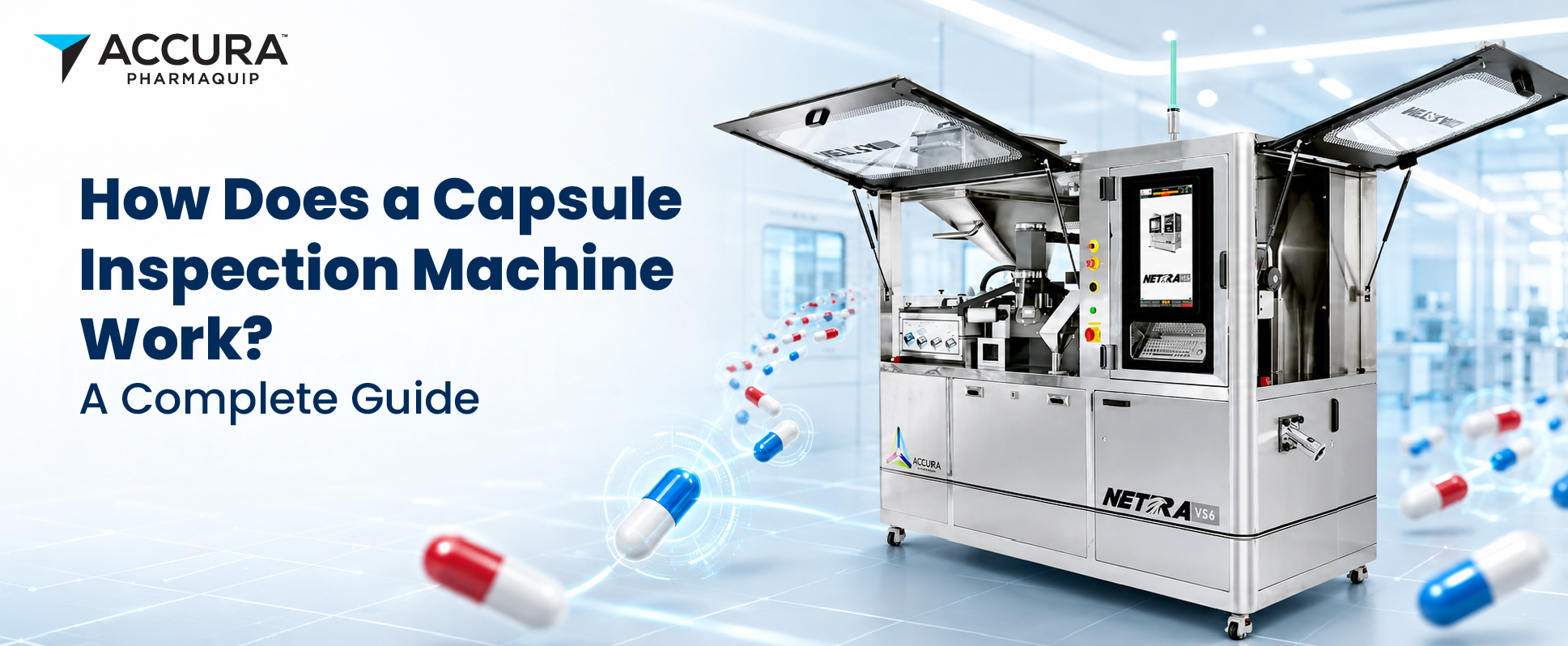
How Does a Capsule Inspection Machine Work? A Complete Guide
In pharmaceutical manufacturing, maintaining consistent capsule quality is essential for product safety, regulatory compliance, and customer confidence. Capsules can develop defects during filling, handling, or processing, making reliable inspection an important part of quality control.
A capsule inspection machine automates the process of examining capsules for visible defects and separating products that do not meet predefined quality requirements. Compared with relying entirely on manual inspection, automated inspection can provide a more consistent and efficient approach for high-volume production.
But how exactly does a capsule inspection machine work? Let’s look at the process in detail.
What Is a Capsule Inspection Machine?
A capsule inspection machine is an automated system designed to inspect filled or empty capsules for various physical and visual defects.
Depending on the machine’s configuration, it may inspect capsules for:
- Cracks and splits
- Dents and deformation
- Improper locking
- Color or appearance variations
- Powder leakage
- Damaged capsule shells
- Incorrect capsule orientation
- Foreign particles
- Other visible surface defects
The machine typically combines controlled product handling, specialized lighting, cameras or sensors, image-processing software, and an automated rejection mechanism.
Why Is Capsule Inspection Important?
Capsule manufacturing involves several stages, including capsule filling, closing, handling, and transfer. Defects can occur at different points in the process.
If defective capsules are not identified, they may continue to downstream operations and potentially reach the packaging stage. Automated inspection provides an additional quality-control layer by examining capsules systematically.
It can also help manufacturers identify recurring production problems. For example, a sudden increase in damaged or improperly locked capsules may indicate an issue that requires attention in the filling or handling process.
How Does a Capsule Inspection Machine Work?
Although machine designs vary between manufacturers, the inspection process generally follows several key stages.
1. Capsule Feeding
The process begins with feeding capsules into the inspection system.
A suitable feeding mechanism distributes capsules into a controlled flow so that individual capsules can be presented to the inspection area. Consistent feeding is important because the inspection system needs a clear view of each capsule.
The feeding system may also help control capsule orientation and spacing before inspection.
2. Capsule Positioning
Once capsules enter the inspection area, they are positioned appropriately for examination.
Depending on the machine design, capsules may be guided, rotated, or transported through specialized channels. Proper positioning allows cameras and lighting systems to capture the relevant surfaces of each capsule.
Some inspection systems use multiple viewing angles to examine different parts of the capsule.
3. Image Capture
The next stage is image acquisition. High-resolution cameras or other sensing technologies capture images of the capsules as they pass through the inspection zone. Controlled lighting is often used to highlight differences between acceptable and defective products.
The inspection system may evaluate characteristics such as:
- Capsule surface condition
- Shape and dimensions
- Color consistency
- Cap-and-body alignment
- Visible cracks or deformation
- Powder leakage or external contamination
4. Image Processing and Defect Detection
After images are captured, specialized software analyzes the collected information. The system compares the observed characteristics with predefined inspection criteria. If the capsule falls outside the accepted parameters, it can be classified as defective. Modern inspection systems can use automated image-processing techniques to identify subtle differences that may be difficult to evaluate consistently through manual inspection, particularly when large numbers of capsules need to be examined.
5. Automatic Rejection
Capsules identified as defective are then separated from acceptable products. A rejection mechanism removes the detected defective capsule from the main product flow. This allows conforming capsules to continue toward the next manufacturing or packaging stage.
An effective rejection system is important because inaccurate rejection can lead to either defective products remaining in the acceptable stream or good capsules being unnecessarily discarded.
6. Inspection Data and Monitoring
Depending on the machine, inspection systems may provide information about rejected capsules and overall inspection performance.
Manufacturers can use this information to monitor reject patterns and identify potential production issues. For example, repeated defects may indicate problems with capsule filling, machine settings, raw materials, or handling conditions.
This makes automated inspection useful not only for identifying defective capsules but also for supporting process monitoring.
What Defects Can a Capsule Inspection Machine Detect?
The exact inspection capabilities depend on the equipment and configuration, but common defects can include:
Cracked Capsules
Capsule shells can develop cracks during manufacturing or handling. Automated visual inspection can help identify visible damage before the capsules proceed further.
Deformed Capsules
Capsules may become dented, misshapen, or otherwise physically deformed. Inspection systems can be configured to identify unacceptable shape variations.
Improperly Locked Capsules
A capsule’s cap and body need to be properly joined. An incorrectly closed capsule can create quality and handling concerns, making closure inspection an important function in many applications.
Color Variations
Changes in capsule color or appearance may indicate inconsistencies that require further investigation. Automated vision systems can help identify deviations from established appearance criteria.
Powder Leakage
Powder around the exterior of a capsule may indicate an issue during filling or closing. Inspection systems can help identify visible leakage or contamination on the capsule surface.
Benefits of Using a Capsule Inspection Machine
Consistent Inspection
Automated systems can apply predefined inspection parameters consistently throughout production.
Higher Throughput
A machine can inspect large quantities of capsules continuously, making automated inspection suitable for high-volume manufacturing environments.
Reduced Manual Work
Automation reduces the need for operators to visually inspect large quantities of capsules individually.
Faster Defect Identification
Defects can be detected during the production process, allowing manufacturers to investigate problems sooner.
Better Process Monitoring
Inspection results can help manufacturers identify recurring defects and evaluate production performance.
Reduced Product Loss
Early detection of defective capsules can help reduce the quantity of non-conforming products moving further through the manufacturing process.
Capsule Inspection Machine vs. Manual Inspection
Manual inspection can still have a role in pharmaceutical quality-control procedures, particularly for sampling and verification. However, inspecting every capsule manually at high production speeds can be difficult.
Automated inspection offers several advantages when continuous, high-volume inspection is required. Machines can operate at consistent speeds and use predefined criteria, while operators can focus on monitoring the system and addressing issues identified during production.
The best approach depends on the manufacturer’s quality requirements, production volume, product characteristics, and overall manufacturing process.
What to Consider When Choosing a Capsule Inspection Machine
Before investing in an inspection system, pharmaceutical manufacturers should evaluate several factors:
Inspection capability: Determine which defects and capsule characteristics need to be inspected.
Production capacity: Ensure the machine can accommodate the required production speed.
Capsule compatibility: Check whether the system can handle the capsule sizes, shapes, materials, and products used in the facility.
Inspection accuracy: Evaluate the machine’s ability to distinguish defective capsules from acceptable ones.
Changeover requirements: If multiple capsule products are manufactured, efficient changeover can help reduce downtime.
Cleaning and maintenance: Consider accessibility, cleaning procedures, maintenance requirements, and the machine’s suitability for the manufacturing environment.
Integration: Check whether the inspection system can be incorporated into the existing production line and connected with other equipment where required.
Conclusion
The basic process involves feeding capsules into the system, positioning them for inspection, capturing images, analyzing their characteristics, and automatically separating defective products. Depending on the equipment, the system can detect defects such as cracks, deformation, improper locking, color variations, and visible powder leakage.
For pharmaceutical manufacturers, automated capsule inspection can provide a consistent quality-control layer while supporting high-volume production and process monitoring. Selecting the right machine requires careful consideration of inspection requirements, capsule characteristics, production speed, integration, and maintenance needs.
Ultimately, the goal of capsule inspection is not simply to identify defective products it is to help manufacturers maintain consistent quality, efficient production, and reliable pharmaceutical manufacturing processes.
FAQ
1. Can a capsule inspection machine inspect both hard and soft capsules?
The suitability depends on the machine’s design and inspection technology. Some systems are specifically designed for hard capsules, while others can be configured for different capsule types. Manufacturers should confirm compatibility with the capsule formats they produce.
2. Can the inspection machine detect empty or underfilled capsules?
Yes, depending on its inspection technology and configuration, a capsule inspection machine may be capable of identifying empty, partially filled, or visibly underfilled capsules.
3. Can capsule inspection machines operate continuously?
Many automated systems are designed for continuous operation and can be integrated into high-volume pharmaceutical production lines. Actual operating capacity depends on the machine model and production requirements.
4. How does lighting affect capsule inspection accuracy?
Controlled lighting is important for machine-vision inspection because it helps create consistent images of the capsules. Appropriate lighting can make defects such as cracks, spots, surface damage, and color variations easier for the inspection system to identify.
5. Can one capsule inspection machine handle multiple capsule sizes?
Many machines support multiple capsule sizes, but the available range varies by model. Change parts, guides, or software settings may be required when switching between different capsule sizes.
6. How can manufacturers maintain reliable inspection performance over time?
Regular cleaning, preventive maintenance, calibration or verification, and routine inspection-system checks can help maintain reliable performance. Operators should also follow the equipment manufacturer’s recommended maintenance procedures and the pharmaceutical company’s quality protocols.
