
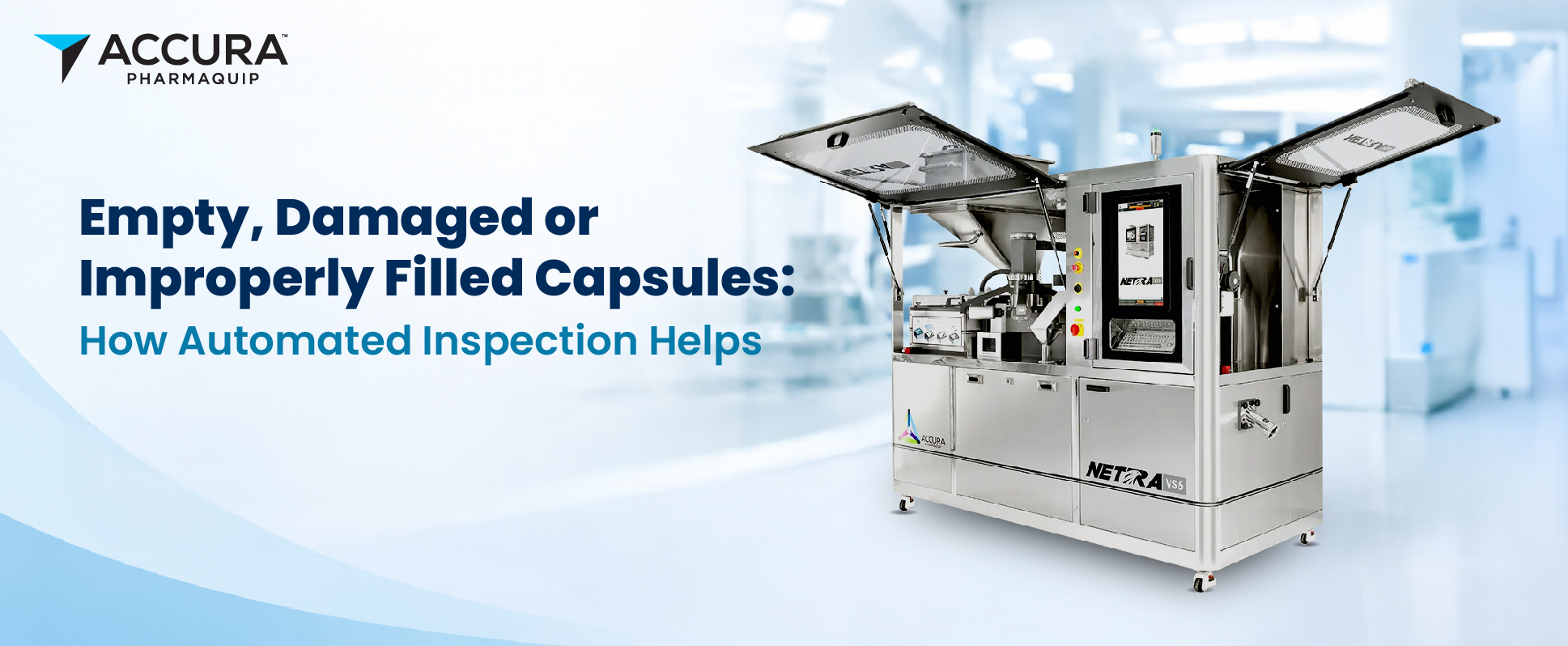
Empty, Damaged or Improperly Filled Capsules: How Automated Inspection Helps
Capsules are widely used in pharmaceutical manufacturing because they provide a convenient and reliable dosage form for many drug products. However, during manufacturing, filling, handling, and transportation, capsules can develop defects that may affect their appearance, integrity, or suitability for further processing.
Empty capsules, damaged shells, improperly filled capsules, loose caps, dents, cracks, and other defects need to be identified before the finished product reaches the next stage of production.
Manual inspection can be useful, but inspecting large quantities of capsules consistently can be challenging. Automated capsule inspection machines use machine vision, controlled lighting, image processing, and automatic rejection systems to inspect capsules at production speed.
What Are Common Capsule Filling Defects?
Capsule defects can occur for different reasons during capsule manufacturing and filling. Some common problems include:
- Empty capsules
- Partially filled capsules
- Improperly filled capsules
- Damaged or cracked shells
- Damaged or cracked shells
- Improper cap and body joining
- Open or loose capsules
- Deformed capsules
- Deformed capsules
- Surface contamination
- Printing or marking defects
The exact defects that can be detected depend on the inspection system, product characteristics, camera configuration, lighting, and programmed inspection parameters.
What Is an Empty Capsule?
An empty capsule is a capsule shell that contains little or no pharmaceutical formulation when it is expected to contain a specific fill.
Empty capsules can potentially occur because of problems with the filling process, feeding mechanisms, formulation handling, or equipment operation.
Automated inspection can help identify capsules with visual characteristics that indicate an empty or abnormal product, depending on the capsule and inspection technology being used.
What Is an Improperly Filled Capsule?
An improperly filled capsule may contain an incorrect amount, uneven distribution, or an abnormal fill condition.
Not every fill-weight problem can be determined through external visual inspection alone. However, visible differences associated with filling or capsule condition may be detectable through machine vision.
This distinction is important: vision inspection should not automatically be considered a substitute for analytical or weight-based testing when those tests are required.
Automated visual inspection is primarily valuable for identifying detectable physical and visual abnormalities.
How Automated Capsule Inspection Works
An automated capsule inspection machine generally follows a series of controlled steps.
1. Capsule Feeding
Capsules enter the machine through a controlled feeding system that helps present individual products for inspection.
Consistent product presentation is important because the vision system needs a clear and repeatable view of the capsule.
2. Capsule Positioning
The capsules are transported through the inspection area in a controlled orientation.
Depending on the machine design, different viewing angles can be used to inspect the capsule body, cap, edges, and surface.
3. Image Capture
High-speed cameras capture images of the capsules as they move through the inspection station.
Multiple cameras or optical configurations can be used when inspection of different surfaces is required.
4. Controlled Illumination
Lighting is carefully arranged to make relevant defects easier to distinguish.
Appropriate illumination can help reveal:
- Cracks
- Dents
- Surface damage
- Colour differences
- Contamination
- Printing abnormalities
- Capsule separation
5. Image Processing
The captured images are analyzed using machine vision software.
The system can evaluate programmed characteristics such as shape, colour, surface appearance, orientation, and other defined inspection criteria.
6. Automatic Rejection
Capsules that fail the programmed inspection criteria can be automatically separated from the acceptable product stream.
This enables continuous inspection without requiring operators to manually identify every defective capsule.
How Automated Inspection Helps Identify Empty Capsules
Identifying an empty capsule through external vision depends on the capsule type, fill material, opacity, lighting, and inspection configuration.
For suitable products, machine vision can identify visual differences associated with empty or abnormal capsules.
For example, the system may analyze differences in:
- Appearance
- Shape
- Surface characteristics
- Colour
- Fill visibility, where applicable
- Capsule condition
For opaque capsules where the contents cannot be visually assessed, external vision alone may not be sufficient to determine fill quantity. In such cases, other process controls or inspection technologies may be required.
Also Read: How Does a Capsule Inspection Machine Work?
Detecting Damaged Capsules
Capsule shells can become damaged during handling or processing.
Automated inspection can be configured to detect visible defects such as:
Cracks
Cracks or splits in the capsule shell can compromise product appearance and physical integrity.
Dents
A deformed or dented capsule may be identified by analyzing its shape and surface.
Open Capsules
If the cap and body are not properly joined, the resulting abnormal appearance can potentially be detected.
Damaged Edges
Vision systems can inspect capsule edges and joining areas for visible abnormalities.
Surface Contamination
Foreign particles or unwanted material on the capsule surface may be detected when there is sufficient visual contrast.
Detecting Improper Cap and Body Joining
A capsule normally consists of two parts: the cap and body. During filling and closing, these components need to be properly joined. An improperly joined capsule may show visible differences around the joining area. Automated vision inspection can examine this region and identify capsules that fall outside predefined visual criteria.
This is particularly useful in high-speed production where manually checking the joining condition of every capsule would be difficult.
Why Lighting Matters in Capsule Inspection
Camera technology alone does not determine inspection performance.
Lighting plays a major role in making defects visible to the camera.
For example, a suitable lighting arrangement can improve the visibility of:
- Surface scratches
- Cracks
- Dents
- Colour differences
- Contamination
- Printing defects
The lighting should be selected according to capsule colour, surface finish, transparency, shape, and the specific defects being inspected.
Benefits of Automated Capsule Inspection
Consistent Inspection
Automated systems apply programmed inspection criteria consistently throughout production.
High-Speed Inspection
Vision-based systems can inspect capsules continuously as they move through the production line.
Automatic Defect Rejection
Detected defective capsules can be automatically removed from the acceptable product stream.
Reduced Manual Inspection Work
Automation reduces the need for operators to perform repetitive visual inspection of individual capsules.
Better Process Monitoring
Depending on the machine and software, inspection data can help manufacturers monitor rejection patterns and identify recurring quality issues.
Multi-Surface Inspection
A suitable camera configuration can provide inspection views of different capsule surfaces, helping increase inspection coverage.
Automated Inspection vs. Manual Inspection
| Feature | Automated Inspection | Manual Inspection |
|---|---|---|
| Inspection speed | Suitable for continuous production | Limited by operator speed |
| Consistency | Programmed criteria | Can vary with operator |
| Automatic rejection | Yes | Usually manual |
| Multi-surface inspection | Can be configured | More difficult at high volume |
| Data collection | Possible depending on system | Usually more limited |
| Operator involvement | Monitoring and intervention | Direct inspection required |
Manual inspection can still have a role in pharmaceutical quality processes, but automated inspection can provide advantages when large quantities of capsules need to be examined consistently
What Manufacturers Should Consider
Before selecting an automated capsule inspection machine, manufacturers should evaluate:
Capsule Characteristics: Consider capsule size, colour, transparency, surface finish, and formulation.
Defect Types: Identify the specific defects that the machine needs to detect.
Production Speed: The inspection system should be capable of operating at the required production throughput.
Camera and Optics: Camera resolution and optical configuration should match the inspection requirements.
Lighting: The illumination system should provide sufficient contrast for relevant defects.
Rejection System: The rejection mechanism should reliably separate capsules that fail the defined criteria.
Validation and Qualification: The inspection process should be appropriately qualified and validated according to the manufacturer’s quality requirements and applicable pharmaceutical procedures.
The Role of Automated Inspection in Capsule Quality Control
Automated inspection is an important part of modern pharmaceutical manufacturing because it allows manufacturers to examine products continuously and systematically.
However, it works best as part of a broader quality-control strategy.
Filling controls + process monitoring + automated visual inspection + analytical testing + final quality checks
Together, these controls help provide a more comprehensive approach to pharmaceutical product quality.
Automated visual inspection is particularly useful for detecting visible physical defects and abnormalities that can be reliably identified through the configured vision system.
Conclusion
Empty, damaged, or improperly formed capsules can create quality concerns during pharmaceutical manufacturing. Automated capsule inspection machines provide a systematic way to examine capsules using machine vision, controlled lighting, image processing, and automatic rejection.
Depending on the product and inspection configuration, these systems can help identify visible abnormalities such as damaged shells, dents, cracks, improper cap-body joining, colour variation, contamination, and other defined defects.
For high-volume pharmaceutical production, automated inspection can improve inspection consistency and reduce dependence on repetitive manual examination. However, manufacturers should select the inspection technology according to the specific capsule characteristics, defects, throughput, and quality requirements of their production process.
FAQ
1. Can an inspection machine detect empty capsules?
It can detect visual characteristics associated with empty capsules for suitable products, but vision alone may not determine fill quantity in opaque capsules.
2. What capsule defects can automated inspection detect?
Depending on the system, it can detect cracks, dents, damaged shells, improper joining, colour variation, contamination, and other visible defects.
3. Can automated inspection detect underfilled capsules?
It may detect certain visually identifiable abnormal fill conditions, but weight or other process controls may be required to verify fill quantity.
4. How does machine vision inspect capsules?
Cameras capture capsule images under controlled lighting, and software analyzes them against predefined inspection criteria.
5. Can defective capsules be automatically rejected?
Yes. Automated inspection systems can use a rejection mechanism to separate capsules that fail the programmed criteria.
6. Does automated inspection replace quality-control testing?
No. Visual inspection is one part of quality control and may need to be combined with other process and analytical tests.
